Wednesday, March 5, 2025

Classroom Observation Blog on Student relation to Shalaby

"Troublemaker"

    A child in my Pre-K school placement who could be classified as a "troublemaker" is an African American boy with an IEP. I've never really heard him speak or say anything to anyone. He tends to not listen to the teacher, the teacher assistants, me, or the other volunteer. When the teacher is delivering a lesson on the rug this boy doesn't stay over there for long and tends to walk away and begins to play with some of the toys around the room. When any of the teachers tried to ask him to return to the rug, he would just continue to play with the toys. My first day was my teacher's first day back from maternity leave, so she was just meeting the students and learning their personalities. I heard one of the teacher's assistants tell the teacher, "You are going to have fun with that one". This is a horrible thing to say in front of the students, even though they are Pre-K and might not even acknowledge or know what they are saying. Once, when the student wandered away from the rug while the rest of the class was watching a video about the alphabet, I followed him and tried to see if he would go back to the rug. But after I asked him multiple times and he didn't go back, I just played with him and kept him company instead of leaving him by himself playing with a toy while the rest of the class was together. He also tends to be destructive by sometimes knocking over blocks that other students are playing with and stacking, which causes the other students to be upset with him. But I calm the students down and tell them they can rebuild it better. I also try to give him some blocks where he can build and knock them down instead of doing it to other towers students make. He tends to just walk away and go play with something else and doesn't play with one thing for long. This causes me to believe that he has a short attention span and will need assistance with staying on task. 

Sunday, March 2, 2025

Troublemakers By Shalaby

 "Preface" and "Introduction" on Troublemakers by Shalaby

These readings focus on students who are considered "troublemakers" and how teachers should respond and act when they have students who are considered "troublemakers" in their class. Teachers need to think about what causes their students to act out. Teachers shouldn't single them out in front of the entire class and punish them when they may just need some extra help. I found multiple parts of this reading very interesting and valuable for future teachers to learn about and use in their future classes. 

When To Speak Up And When To Be Silent — CHRISTINE KOH

The first reading started with lyrics from the song "Something Inside So Strong" by Labi Siffre. Labi Siffre states, "The more you refuse to hear my voice, the louder I will sing."  I found these lyrics interesting because they focus on how the more someone is silenced, the more they will try to speak up. This relates to how minority groups continue to be silenced for the injustices that they face and how they have to continue to challenge the system that continues to silence them and oppress them.

The first reading later talks about how miners used to bring a caged canary down into a mine to alert the miners to carbon monoxide poisoning. The canary was able to sense the carbon monoxide before the miners, which allowed the miners to escape their deaths, but the canary died because the miners valued their lives over the canary's. This is a valuable example not just for teachers but for all people to learn from. People need to understand that no one is more valuable or important than someone else. Shalaby writes, "...we are in the habit of incarcerating the people from whom we could learn the most about freedom, we cage the birds singing most loudly." People that we could learn from regarding their life experiences are the ones who tend to be punished and silenced causing our society to be the same and never change.

Idioms in the News: Canary in the Coal Mine | ShareAmerica

The second reading further focused on students who are considered to be difficult for the teacher to teach or keep focused. It also focuses on what teachers think of their students regarding how easy they are to work with. Shalaby states, "We generally think of 'deviance', and of deviant people, as a problem. I have learned to think of deviance as informative, and often as an exercise of power and free will." The author believes that students who are "problems" tend to use their rights to share their opinions and beliefs. The author wrote about a student who always challenged a teacher's instructions and never did an assignment that they didn't want to do or find interesting. In this case, the teacher may have either put in the extra effort to keep the student engaged with different lessons or provided extra help to make the student enjoy the lesson or activity.

Teachers need to be aware that every student is capable of greatness, and some just need the right tools to be successful. Teachers have to be insightful and alert, they have to notice things about their students that others may not notice to allow their students to get the help that they need to be successful. 


Sunday, February 23, 2025

PUblic Education and Ethnic Studies

"A Short History of Public Schooling" and "The Academic and Social Value of Ethnic Studies":

Schools initially aimed to subordinate children and get them in the mindset of being subordinated, so they grew up as subordinates. This is a terrible thing for a school to accomplish, schools should make their students become people who are well educated, able to make their own opinions and challenge societal issues. Schools began to incorporate ethnic studies to make the curriculum in courses more representative of all people, not just whites. I found multiple parts of the reading interesting, and I found quotes to highlight certain sections.

Christine E. Sleeter writes, "Of the 96 Americans who were named for study in the Framework's course descriptions, they were 77 percent White, 18 percent African American, 4 percent Native American, 1 percent Latino, and 0 percent Asian Americans"(2). This book mainly focused on white people and very little on people of color. They should make each ethnicity equally represented and represented in a fair way and not just be portrayed as victims. If textbooks make a race, specifically those of color victims, students could internalize that message and believe that they are just victims in this society. 

Another quote I found interesting discussed the different beliefs of white students and African American students. Sleeter states, "For example, although White fifth graders believed that the Bill of Rights gives rights to everyone, about half of the Black children pointed out that not everyone has rights"(3). These students experienced different issues in their lives, which caused their opinions about rights to vary. African Americans on paper have the same rights as white people, but our society doesn't treat everyone equally even though they all have the same rights. 

The final quote I found focused on how white adults do not realize that school curriculums don't include or focus on multiple cultures and ethnicities. Sleeter writes, "White adults generally do not recognize the extent to which traditional mainstream curricula marginalize perspectives or communities of color and teach students of color to distrust or not take school knowledge seriously"(4). White adults don't realize that schools mainly focus on white culture and how this would affect students of color. Students of color would not feel represented in their school curriculum, which would cause them to not feel a part of their school community. Ethnic study courses allow students to become inspired and may even pursue further education to learn about their culture and use what they learn to teach others. 

Chemistry textbooks still lack gender and racial representation

After reading and watching the video, I could see more of the impact and value of ethnic study courses and their positive effect on students, schools, and communities. It is very important that school curricula value all ethnicities and bring equal attention to all of them and make them all equally valued. If schools don't highlight all ethnicities and cultures, students will not feel welcomed at that school or community.


Sunday, February 16, 2025

The Four I's of Oppression and Intersectionality

Luna Malbroux's The Four I's of Oppression and Learning for Justice's Intersectionality:

Luna Malbroux argues that there are four kinds of oppression, and these forms of oppression vary for everyone due to the privilege they were born with, which relates to intersectionality. Malbroux classifies the four forms of oppression as ideological, interpersonal, institutional, and internalized. All four of these oppressions relate to people's beliefs and feelings towards others who are different from them. She then provides ways for people to solve these forms of oppression or beliefs that they have internalized about others or themselves. 

The first form of oppression is ideological, which is rooted in our value systems that allow people to dehumanize, take advantage of, or harm other people due to them being different than them. A way to solve this form of oppression is to start the long process of social, political, economic, and cultural change. This would require everyone to work together; no one person or group can solve this issue by themselves. Another form of oppression is internalized. Internalized oppression addresses the way people absorb belief systems that lead to feelings of false supremacy and deficiency within themselves and with others. To challenge this form of oppression, people have to be taught or teach themselves about "liberation learning". This means that people have to learn about injustices and see if they hold an opinion towards a group of people due to past events. The third form of oppression is interpersonal. Interpersonal is a way internalized oppression is expressed between people either by accident or on purpose. People can say something that seems like a compliment, but it is actually an insult because they are surprised by a person being good at something due to who they are. A way to challenge this oppression is taking accountability and changing your way of thinking. The final one is institutional oppression, which is the way oppression is perpetuated socially through policies, laws, and social practices. Ways to solve this involve transparent, dedicated, accountable, diversity, equity, and inclusion work towards change. These forms of oppression will all take a while to eliminate from our society. To remove them, every person, no matter what they look like or what power or privilege they have, needs to unite and listen and respect each other.

5,843 Oppression Stock Vectors and Vector Art | Shutterstock

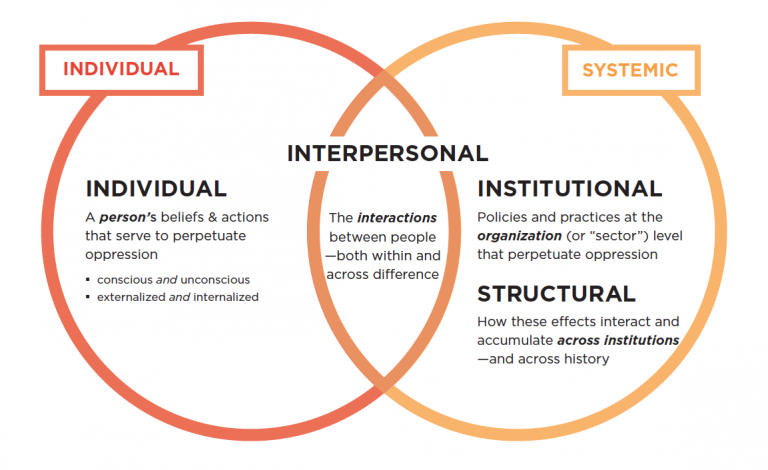
After doing the reading and watching the videos, I believe that not every person will experience oppression, and if they do, no one person experiences oppression in the same way. People are born with privileges and power, which gives those with privilege and power the additional privilege of not having to face oppression. Finally, the graphic below is from Lens of Systemic Oppression — National Equity Project, which explains oppression and questions to ask regarding oppression. 


Lens of Systemic Oppression — National Equity Project

Sunday, February 9, 2025

Other People's Children

 Leo Labonte

Other People's Children

Lisa Delpit describes situations in which teachers make assumptions about students or fellow teachers based on their race or background. Some teachers don't understand that they are born with power or privilege, which affects their classroom environment and the student-teacher relationship. Some teachers try to point out issues to their colleagues, but some ignore what their colleagues have to say because they haven't faced these issues and don't see them as a problem they need to address. There were multiple interesting points that Delpit writes about, but I highlight a few that I found very interesting while I was reading. 

At the beginning of the reading, Delpit described how an African American teacher was trying to convince their white colleagues that they needed to do more work with their African American students, but their colleagues didn't take them seriously, so they had to step up to pick up the slack. Delpit states, "You can only beat your head against a brick wall for so long before you draw blood"(21-22). People can challenge issues that they see, but after a while, it becomes tiresome and aggravating to continue to fight it. The African American teacher can't make her colleagues more open-minded and change their teaching methods. The teacher will eventually only worry about what she can do because it is too challenging to change someone's mind who doesn't think about issues that they don't face. 

Another section that I found interesting was when Delpit described the power in a classroom and how there is a delicate balance. As a teacher, you can't be super strict where the students are afraid to express themselves, are speaking up or being too friendly and the students walk over you and don't respect you. Teachers need to realize that students may have an understanding about what you are trying to teach them or may know something that you don't know that relates to a class topic. Teachers need to respect a student's opinion and not instantly deny them and expect them to be wrong because they are younger than the teacher. Delpit writes, "To deny students their own expert knowledge is to disempower them"(32-33). By saying a student is wrong without being sure, you are taking away what power the student has and their confidence. This may also cause students not to volunteer in classroom discussions because the teacher will assume that they are wrong.

How Do You Handle Uninterested Students as Learners?

Finally, teachers need to make their classrooms a place that is welcoming to all and that highlights multiple cultures. Teachers need to share the issues that the community, society, or world are facing, and by doing this, it allows students to be aware of what others around them are facing and to be more prepared to challenge the issues in the world. Delpit states, "And finally, we must learn to be vulnerable enough to allow our world to turn upside down in order to allow the realities of others to edge themselves into our consciousness. ...Teachers are in an ideal position to play this role, to attempt to get all of the issues on the table in order to initiate true dialogue. This can only be done, however, by seeking out those whose perspectives may differ most, by learning to give their words compete attention, by understanding one's own power,..."(47). Teachers need to share opinions and beliefs that the students and the teacher themself may not experience in their life and by doing this they all start to understand others that are different than them.

Overall, from this reading, I learned that teachers need to be aware of their additional job of challenging issues in the world and educating their students on these issues so their students can also make the world a better place because everyone has to work together for the world to change for the better. Teachers shouldn't give up in difficult situations and need to set an example for their students. 


Sunday, February 2, 2025

Alan Johnson's Privilege Power and Difference Argument

 Leo Labonte

Alan Johnson's Privilege Power and Difference

Alan Johnson argues that if we ignore certain words that people find "uncomfortable", we only prolong their damage and effect on our society and on people deemed below others with no privilege. Johnson says that the purpose of this reading is to change how people think, which then changes how people act and their role in the world. This then causes the world to change by people making the necessary changes to it.

Johnson mentions how there are many differences in our world. Such as a person's gender, race, ethnicity, sexual orientation, class, age, education, or profession. He believes that class differences can be changed, but the other differences are much harder to change due to prejudices and beliefs that people have or make about others. 

He then went on to describe certain privileges that people have over others. Men have privilege over women, white people have privilege over non-white people, and heterosexuals have privilege over homosexuals. These are the privileges that Johnson mentions, but there are many more privileges that people possess. Men tend to hold most of the more powerful positions in society while women hold few of those positions. White people have less to worry about compared to non-white people due to the resources they have, the police, or other people in their society. White families have an average wealth that is ten times that of black families. Heterosexuals don't have to worry about how their family, friends, or others may react, but homosexuals have to worry about what others may think of them or do to them. 


If we ignore the words like, "white racism", "sexism", "homophobic", or privilege itself it keeps us in a state of unreality, by promoting the illusion that difference by itself is the problem. Those who are born or given a privilege must help those who don't have a privilege because they can not do anything to change or solve the problem by themselves because they do not have the power or resources to solve it. People must use their privilege to get rid of privileges in our society. Everyone no matter what they look like, their background, what they classify as, or who they love, need to have the same chances and opportunities. This would allow privilege to disappear from our society.

After reading Johnson's Privilege Power and Difference I learned that if change is ever going to happen in our society everyone must unite to make a change, not just those who are facing these issues personally. You must challenge issues that don't even affect you because if the world is going to become a better place everyone has to work together. Those that have power and resources and those that don't.


Blog #11 Reflecting on the Semester

 Reflecting on the Semester This course has given me a lot of useful knowledge that I plan to use in my future classes at RIC and my future ...